
 R.C
R.C Hello, friends of Crazy about Korea! Today I propose a magical trip. If you ever saw a Sageuk (historical drama) And they dreamed of walking between ancient palaces, tombs covered with grass and temples on the mountain, then their destination has a name: Gyeongju.
Located on the southeast coast of Chorea, , Gyeongju It is not just any city. It was the capital of the legendary Chair kingdom (57 B.C. – 935 AD) For almost… A thousand years! It is so rich in history that it is known worldwide as the ‘Houseless Museum’.
Currently, the city is on everyone’s lips, since it was chosen as the venue for important international summits, demonstrating that its mixture of ancient history and modernity is world-class.
If you are planning a trip to Korea or simply love their culture, we have prepared the definitive guide on What to see in Gyeongju. Let’s travel back in time!
Silla’s legacy: A walk through the royal tombs
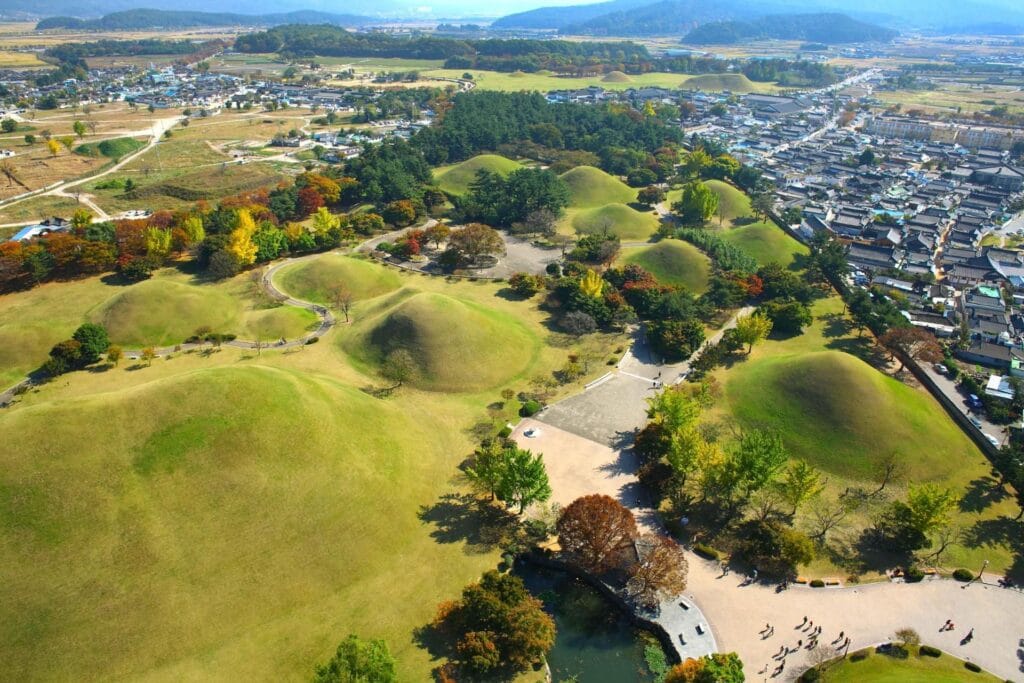
The first thing that will impact you when you get to Gyeongju They are their TUMULI: Gigantic hills of perfectly rounded grass that rise in the heart of the city. They are not natural hills; They are the tombs of kings, queens and nobles of Chair, built between the centuries IV and VI.
The main complex is called Daereungwon. Walking between these mounds is a serene and magical experience, where the past and the present coexist literally side by side.
Cheonmachong: the tomb of the heavenly horse
Although most of the tombs remain sealed (keeping secrets of a thousand years), one of them is open to the public: Cheonmachong or the ‘Celestia Horse TombL’.
excavated in 1973, inside it was an amazing treasure: more than 11,000 Artifacts, including a spectacular solid gold crown. But its name comes from a unique painting found on a saddle protector, showing a winged white horse galloping through the clouds. It is a must-see to understand the power of Silla!
Travel to the world with the best discounts on air and accommodation only here!!!
Reung, Chong or Myo? The secret of names and how to understand tombs
You will see that the tombs have different names. It’s simple:
- Reung (or Neung): They are the largest tombs, where it is known which king or queen is buried (e.g.. Seondeokyeowangreung, the tomb of Queen Seondeok).
- Chong: They are real tombs, but who they belong to has not been identified. They are named for the treasure found (e.g.. Cheonmachong, tomb of the heavenly horse, or Geumgwanchong, tomb of the golden crown).
- my: It is the word for smaller tombs or for non-royal people.
Gyeongju icons you can’t miss
Beyond the tombs, the legacy of Chair It’s in every corner. If you wonder what to see in Gyeongju, these are the points that cannot be missing in your itinerary.
Cheomseongdae: Queen Seondeok Observatory
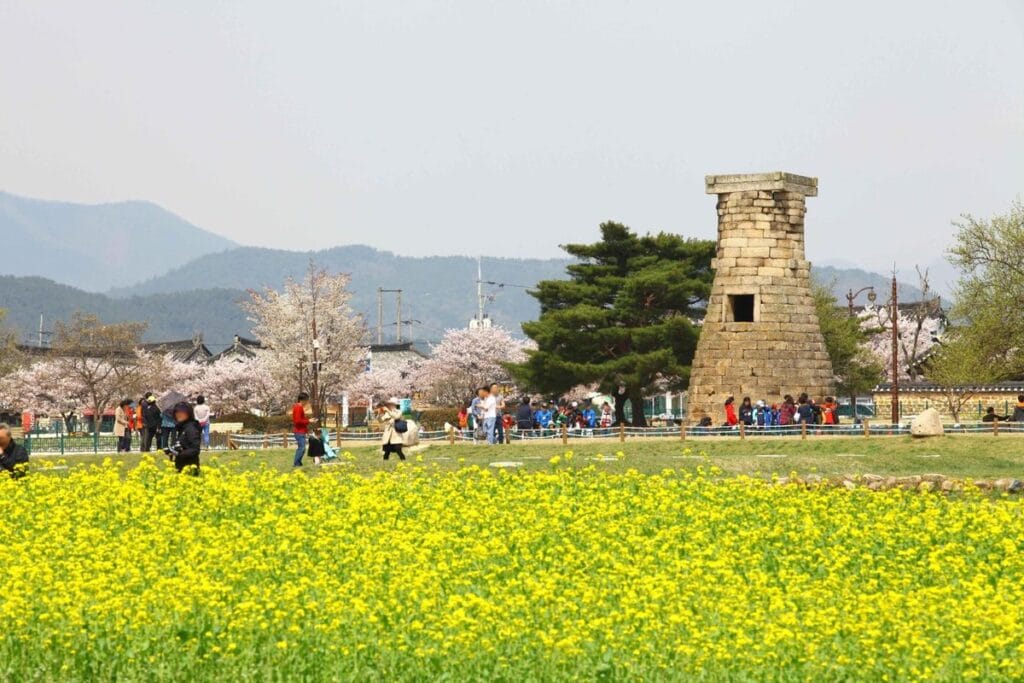
This elegant 9-meter stone tower is a symbol of the city. It is believed that it is The oldest astronomical observatory that still exists in Asia.
But the most fascinating thing is who sent it to be built: the legendary Queen Seondeok, the first ruling queen in the history of Chorea. In a time of great agitation and being a woman, Seondeok She was a brilliant leader. Building this observatory was a bold declaration of sovereignty, showing that Chair He had his own power to ‘Read the heavens‘, a privilege that at that time was believed to be reserved only for China.
Donggung Palace and Wolji Pond: A Dream Night
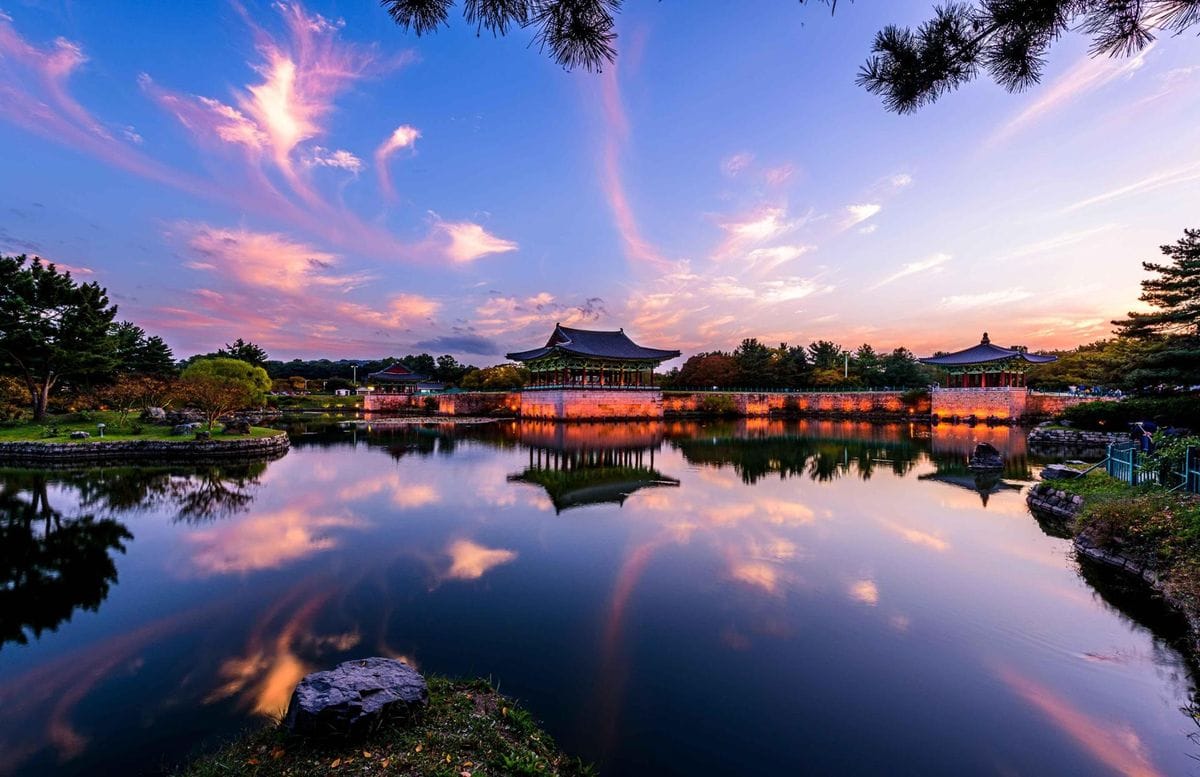
If your Instagram needs a spectacular photo, this is the place. popularly known as ‘ANAPJI‘, this was the secondary palace of the Crown Prince of Chair, used for banquets and celebrations.
By day it is beautiful, but at night it is absolutely magical. The pavilions light up and are perfectly reflected in the calm waters of the pond Wolji. It is a romantic walk and one of the most famous night landscapes in all of Korea.
The heart of Silla: Gyochon Village, the main palace and a dream bridge
If he Wolji pond It was the party place, very close to there we find the nerve center of real life and noble of Chair.
Banwolseong Palace (the site of the main palace)
While Donggung It was a secondary palace, the real power center of the kingdom during 1,000 years was Banwolseong, known as the ‘Half Moon Palace‘By the shape of its walls.
Today you will not find large reconstructed buildings (it is an active excavation site and a beautiful park), but walking through its land is stepping on the same land as the kings of Chair. The essential visit here is the SeoKinggo: A ‘refrigerator’ of antiquity! This incredible underground stone structure was used to store ice throughout the year. It is a fascinating stop that shows you the level of ingenuity and technology that the kingdom possessed.
Gyochon traditional village
Right next to the palace is the Gyochon traditional village. If Hwangridan-Gil is the version trendy of a Hanok, , Gyochon is the version authentic and traditional. This village was the home of the wealthy clan Choe de Gyeongju, and today it is the perfect place to live the culture of Chair.
Here you don’t just come to take photos; you come to do. It is the center of the Cultural experiences: You can take traditional pottery classes, learn to do tteok (rice cakes) or visit the old Confucian school.
Woljeonggyo Bridge (The Magic Bridge)
connecting the Gyochon Village With the rest of the historic park, you will find one of the most impressive postcards in Gyeongju: the Woljeonggyo Bridge.
This is the largest covered wooden bridge in Chorea, superbly rebuilt in the style of Chair. If by day it is impressive, at night it is a show that you cannot miss. Illuminated over the Namcheon stream, it competes directly with the Wolji pond for being the Best night walk in town. A magical place to close the day!
Bulguksa Temple and Seokguram Grotto: The jewel of UNESCO
Get ready to be amazed. On the outskirts of the city, on the side of a mountain, there is the Bulguksa Temple. This complex is a masterpiece of Buddhist architecture of Chair, with its famous stone pagodas (Dabotap and Seokgatap) and stair bridges that symbolize the ascent to the land of Buddha.
A little further up the mountain, is the Seokguram Grotto. Inside this artificial grotto, one of the most beautiful Buddha statues in the world awaits you, carved in granite and looking serenely towards the East Sea. both sites are UNESCO World Heritage Site And a must visit.
You can also read Latin America and K-Beauty
The vibrant present: where the ancient joins the modern
But Gyeongju It’s not just ancient history. In recent years, the city has been able to reinvent itself, attracting thousands of young Koreans and tourists.
Hwangridan Street: Gyeongju’s ‘Trendy’ neighborhood
If he Seoul has A Ikseon-dong, , Gyeongju has A Hwangridan-Gil. This area, located right next to the royal tombs, has transformed the traditional houses Hanok In the cafes more trendy, Craft bakeries, fusion restaurants, photo studios and art boutiques you can imagine.
It is the perfect place to have a coffee, try amazing desserts and feel the energy of the Chorea Modern, all while you have direct views of the ancient tombs. The mix is unique!
The Bomun Tourist Complex: Nature and Relaxation
for families, couples or those looking for a break in Chorea, there is the Bomun Lake. This is a huge resort developed in the 70s, surrounding a beautiful artificial lake.
It is the epicenter of leisure: luxury hotels, golf courses, water parks and bicycle trails. In spring, the entire lake is lined with millions of cherry blossoms, creating one of the most famous natural shows in the country.
Gyeongju, a living canvas: 21st century chair art
Gyeongju It is also an art center that merges millennia.
Gyeongju National Museum: the glitter of chair gold
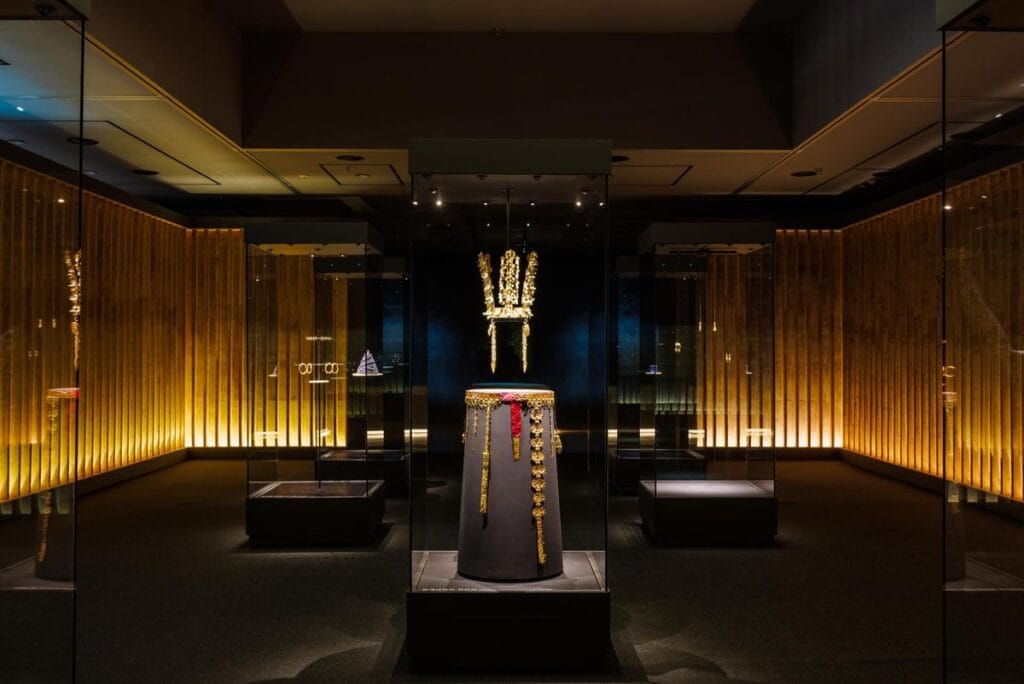
To understand the magnitude of what was ChairYou have to visit this museum. It houses thousands of relics, from ceramics to dazzling gold crowns.
Recently, the museum made history by Gather the six golden crowns of chair For the first time in more than 100 years. Seeing these treasures in person leaves you breathless and makes you understand the level of sophistication and wealth of the ancient kingdom.
Contemporary Art: From Nam June Paik to the Solgeo Museum
The city also vibrates with modern art. The Wooyang Art Museum Presents exhibitions of world-class artists, such as the pioneer of video art Nam June Paik. one of his works, ‘Horse robot‘, it is directly inspired by the ancient terracotta warriors found in the tombs of Gyeongju, connecting the 5th century with the information age.
Gyeongju awaits you
with almost 9 million of visitors per year, Gyeongju It’s not a secret. It is the throbbing heart of Korean history, a place that knew how to honor its glorious past while embracing a vibrant present and trendy.
If you are looking for a destination that offers you deep culture, dream landscapes, delicious gastronomy and perfect corners for your photos, you know what to see in Gyeongju. It’s a must stop on your adventure by South Korea!
Frequently Asked Questions (FAQs): Everything you need to know for your trip to Gyeongju
We know that after reading this, you are already packing! Here we solve those practical doubts so that your trip to the heart of Chair be perfect.
1. What is the best way to travel from Seoul to Gyeongju?
You have two main options!
- The fastest (KTX): The high-speed train (KTX) is the most efficient way. It takes approximately 2 to 2 hours and 30 minutes From Seoul station to the Singyeongju Station (eye: New Gyeongju). This station is about 15-20 minutes by taxi or local bus from the historic center (where the tombs and Hwangridan-Gil are).
- The most direct (bus): You can take an express bus from the Seoul Express Bus Terminal (in Gangnam). The journey is longer, lasting between 3 hours 45 minutes and 4 hours, but it has the great advantage that it leaves you at the Gyeongju bus terminal, which is right in the center of the city!, steps from the tourist areas.
2. How many days do I need to see Gyeongju?
This is the million dollar question. Although you could see only the essential On a very busy day (arriving early and leaving late), We recommend a minimum of 2 full days and 1 night.
This gives you time to see the historic center (Tumbas, Cheomseongdae) and the Trendy neighborhood of Hwangridan-Gil one day, and dedicate the second day to the places that are on the outskirts, such as the Bulguksa Temple and the Seokguram Grotto, without haste. If you want to explore more calmly or visit the Bomun Lake, 3 days is ideal.
3. What is the best time of year to visit?
Gyeongju It’s beautiful all year round, but it’s world famous for two seasons:
- Spring (late March – early April): It is the high season of the cherry blossoms. The whole city is dyed pink, but the main spectacle is on the trails that surround Lake Bomun. It’s dreamy!
- Autumn (October – November): For many, this is the best time. The weather is perfect, and you can see the fall foliage at Bulguksa Temple. In addition, near the Cheomseongdae Observatory the famous Herb ‘Pink Muhly’ (Muhlenbergia capillaris), creating a pink field that is crazy on Instagram.
4. How do I move inside the city? Do I need a car?
No car required! Gyeongju It is very tourist friendly.
- On foot: The main historic core (Daereungwon, Hwangridan-Gil, Cheomseongdae, and even the Wolji pond) is very flat and can be walked perfectly.
- Bicycle: It is one of the most popular ways to explore. There are many bicycle rental locations (even some vintage Super cute!) to stroll through the historic areas.
- Local bus / taxi: to go to the most remote places such as the Bulguksa Temple and the Seokguram Grotto (which are about 30-40 minutes from downtown), you will have to take a local bus (numbers 10 and 11 are the most famous for that route) or a taxi.
5. What typical food or snacks should I try at Gyeongju?
You can’t leave without trying this!
- SSAM-BAP: It is the most traditional dish in the city. It is a feast that consists of meat (as BULGOGI or spicy pig) and dozens of small side dishes (BANCHAN) that you wrap (ssam) in different types of lettuce and fresh leaves.
- Hwangnam-Pppang (Gyeongju bread): The souvenir Edible par excellence. It is a small, very fine sweet roll, stuffed until it bursts with red bean paste (Azuki) and with a chrysanthemum stamped on the top. Delicious!
- 10-Won Bread (10-Won Bread): The most ‘instagramable’ snack on Hwangridan-Gil street. It is a cupcake in the shape of the old 10-wone coin, stuffed with mozzarella cheese that stretches a lot when biting it.

Mark Lee Leaves NCT and SM Entertainment After 10 Years
The Comeback of the Century! Everything About BTS’s “Arirang”, the March 21 Concert, and Their Global Impact
Why Did BTS Name Their New Album Arirang? The Secret Behind the Meaning of Its 14 Songs
BTS and The Deep Historical Meaning Behind Their Mega Concert in Gwanghwamun
“The King’s Warden”: The Box Office Smash Hit That Sparked an Unusual Digital Revenge in Korea


Nice post. I was checking constantly this blog and I’m impressed! Extremely helpful information specifically the last part 🙂 I care for such info much. I was looking for this particular info for a long time. Thank you and good luck.
Thank you!!!
This is the fitting blog for anyone who needs to seek out out about this topic. You realize so much its virtually arduous to argue with you (not that I actually would want…HaHa). You positively put a brand new spin on a subject thats been written about for years. Nice stuff, just great!
[…] You can also read What to see in Gyeongju? The Ultimate Guide to South Korea’s “Houseless Museum” […]